
Playte
About
Games
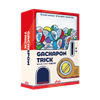
Gachapon Trick
Gachapon Trick is a sharp, modern trick-taking game that captures the joy of a capsule-toy machine: quick decisions, calculated risks, and the thrill of collecting the perfect set. Players battle through tense tricks to win figurines, but victory in a trick is only the start—what truly matters is how your haul scores. Building sets of matching toys pays off dramatically, while mismatched finds offer only modest points, creating constant pressure to read the table and pivot your plan.
What makes Gachapon Trick stand out is how cleanly it layers set-collection incentives onto classic trick-taking psychology. Every hand asks a satisfying question: do you fight for a specific toy to complete a high-value set, or play conservatively to deny opponents their biggest swing? The result is a game that is easy to teach, fast to replay, and full of “I can’t believe you went for that!” moments—without needing complicated rules.
Designed for 2–4 players in around 30 minutes, Gachapon Trick delivers high interaction, strong pacing, and a distinct theme that feels instantly approachable yet strategically rewarding. (14+; 50 cards + coin tray.)
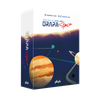
Orapa Space
ORAPA SPACE takes the familiar thrill of deduction and makes it tangible: instead of asking yes/no questions, you fire a laser into your opponent’s hidden space grid and read the experiment’s outcome. Each shot returns two clean data points—where the beam exits the grid and how its colour changes—turning every turn into a vivid, testable hypothesis.
The novelty isn’t just “a laser in a board game.” It’s the two-channel information design that creates satisfying, visual logic: planets redirect beams with different reflection behaviours, while colour is evidence that stacks—mixing as the beam encounters multiple planet colours (and even shifting into special shades when white is involved). That means players aren’t only mapping positions; they’re reconstructing interactions and sequences, producing frequent “wait… that can only happen if…” moments.
For groups, ORAPA SPACE scales elegantly: at 2 players, you’re both scientist and saboteur; at 3+ one player becomes the mission controller who answers, while explorers race to solve.
And when players want a higher ceiling, the Black Hole Expansion adds a genuinely fresh twist: lasers can bend (refraction) when passing near a black hole, vanish on contact, or even become trapped inside the grid—new outcomes that feel intuitive, dramatic, and instantly table-talk worthy.
In short: a deduction game where the core “question” is a physical experiment—and the answer arrives as geometry + colour.